
Do You Really Understand What You’re Teaching?
Photography Pilates Anytime
One of the best pieces of advice I was ever given early in my teaching career was this:
“If someone walked into your class mid-session and asked you to explain what you were teaching your client, could you?”
Could you articulate how the movement they are doing fits into the bigger picture of your client’s progression? Does it have a reason? That idea has stayed with me ever since.
Because if you can’t express why you’re teaching something or what you’re asking your client to do, it usually means you don’t yet understand it deeply enough yourself. And if that’s the case, perhaps you shouldn’t be teaching it. At least, not yet.
I share this thought with all my teacher-trainees because
“I believe that in order to teach an exercise effectively, you need to feel it in both your heart and your head. You need to understand it and embody it to be able express it.”
You can layer on all the cues, modifications, props, and creative variations you like,
“but if you don’t understand the heart and structure of the original movement, then everything else is just decoration.”
As teachers, we must know why we’re choosing an exercise, not just how to perform it.
Photography Pilates Anytime
Embodiment Doesn’t Mean Perfection
Now, that doesn’t mean we have to be able to perform every exercise perfectly in our own bodies. Life happens, injuries, age, accidents, asymmetries, all of which can influence what we’re physically capable of doing.
But what we do need is a genuine understanding of the essence of the exercise: its purpose, its direction, its breath, its relationship within the system.
Challenge of the “Copy and Paste” Era
In today’s world, it’s easier than ever to see an exercise on social media and think, “Oh, that looks good, I’ll teach that today.”
But seeing and doing are not the same as understanding. The integrity, the nuance, the why behind an exercise can’t be learned from a 30-second clip.
Photography Pilates Anytime
The Power of Questions
Students, clients, trainee teachers and experienced teachers should always feel empowered and safe to ask why.
And as teachers, we should welcome those questions. They keep us sharp. They make us reflect. Sometimes, they even reveal the gaps in our own knowledge, gaps we can then explore and fill.
That’s how we grow as teachers, and as movers.
Because at the end of the day, teaching Pilates isn’t about imitation, it’s about understanding and passing that understanding onwards when we teach.
In short:
Don’t just do it: know it.
Don’t just teach it: embody it.
And never stop asking why.
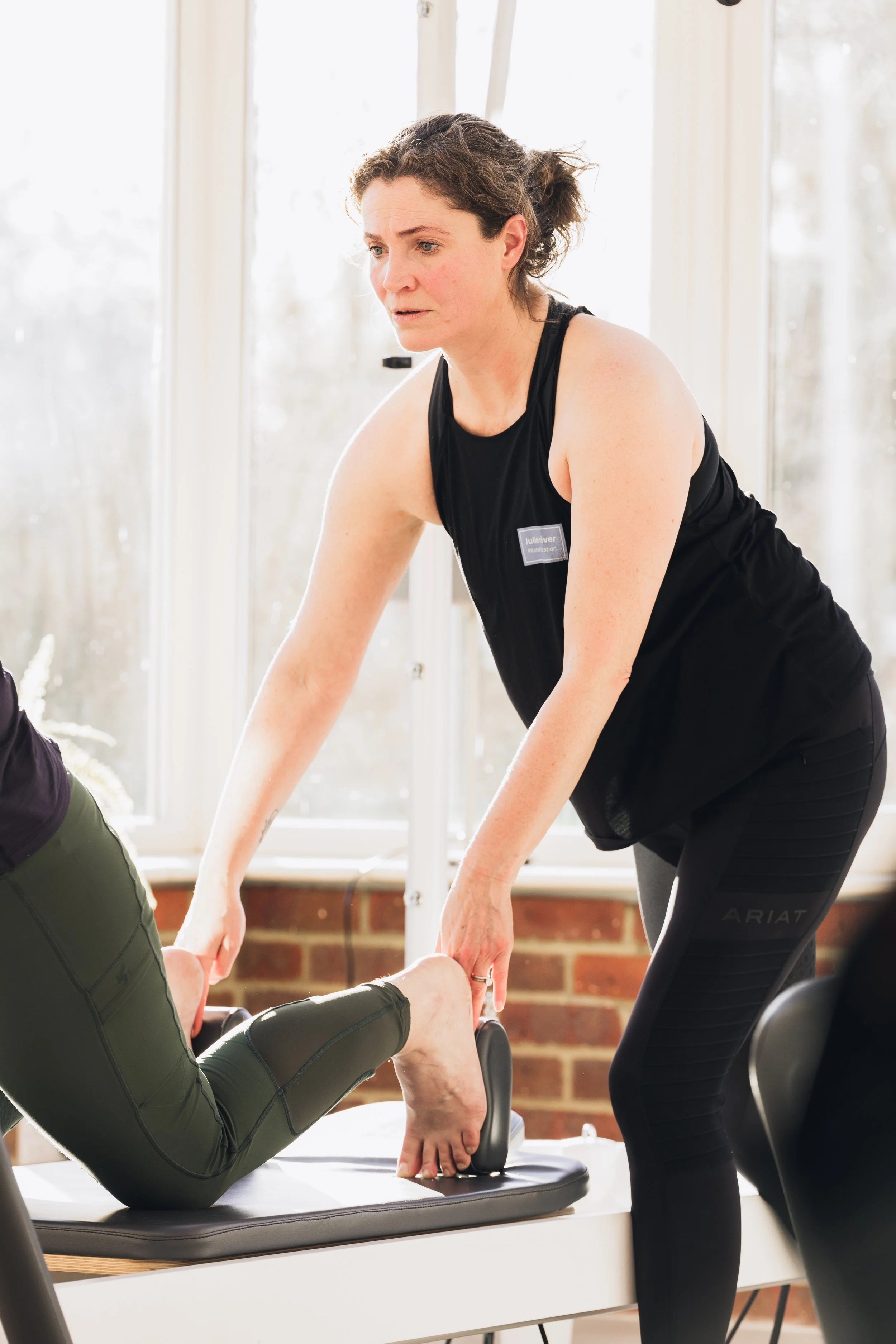
JULIE DRIVER is based in North London and has been teaching for over 23 years both in the UK and Internationally.
Julie coaches equestrians of all levels from the weekend rider to the elite athlete and is currently the Pilates teacher for the Wesko Foundation three-day-eventing team. Julie considers Pilates to be the perfect way for riders to improve their technique and create a stronger and deeper relationship with their horse.
A serious ski accident in 2008 caused extensive damage to her left leg and surgeons predicted a year-long recovery and a permanent limp. With the support and skill of her physiotherapists along with her own knowledge of Pilates Julie was able to walk unaided without a limp in less than 9 months.
In 2014 Julie was awarded the title of “Pilates Anytime” International Instructor of the Year.