
The value of Footwork on the Reformer
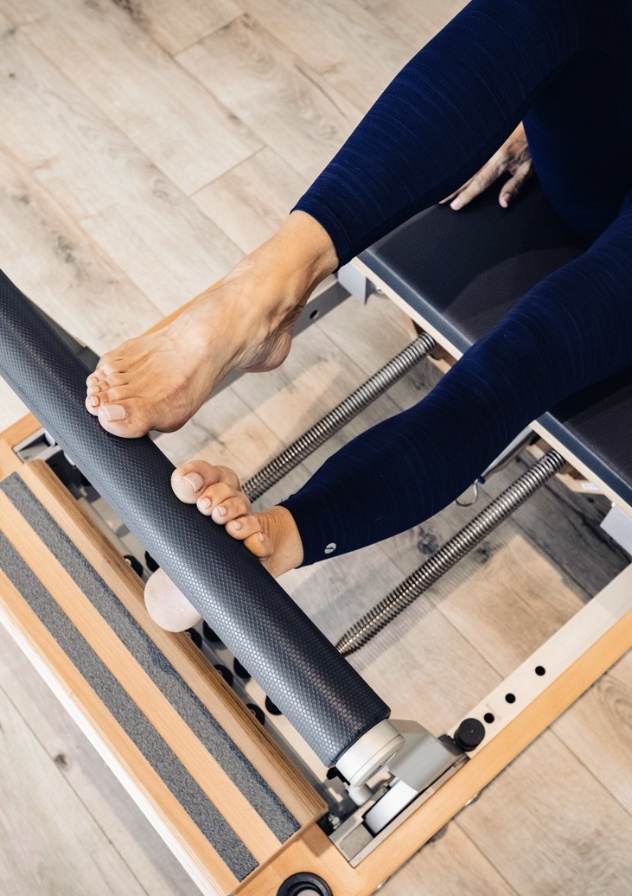
There has been much discussion recently on social media platforms about the value of Footwork on the Reformer, and whether it needs to be taught as the first exercise in every session, or indeed taught at all.
Firstly, let’s review the history of Footwork:
Joseph Pilates developed the concepts for his equipment and its repertoire during his World War 1 internment on the Isle of Man circa 1914-18. So the legend goes, he attached springs to bedframes, using them to create exercises that involved both the feet and the rest of the body.
After the war, he continued to develop his method and equipment, and opened his own studio in New York City, USA circa 1926.
In Classical Pilates, Footwork is considered a cornerstone of the Reformer repertoire, vital for warming up - Pilates emphasised starting Reformer sessions with Footwork (traditionally Toes, Arches, Heels & Tendon Stretch) because they provide a strong foundation for proper alignment, circulation and overall body mechanics. He viewed Footwork as a way to engage the muscles in the legs and feet to develop strength, improve foot function and establish connections between the lower body and the rest of the body.
With the passing of time and a big emphasis over the past few years in particular of teaching functional exercise, and relating it to activities of daily life, some studios and instructors are choosing to omit Footwork in a supine position, which prompts the question, what relevance does doing Footwork on the Reformer have today?
I asked Wayne Seeto, Merrithew Master Instructor Trainer & Director, Education Programming, Master of Sciences (Physiotherapy) for his view and he said the following:
“Footwork on the Reformer is a powerful tool for Pilates Instructors to retrain the lower kinetic chain—the hip, knee, ankle, and foot—as a functional unit. By varying foot placement, spring resistance, and alignment, we reinforce the STOTT PILATES® 6Th principle of Lower Body Mobility & Stability while enhancing proprioception, joint stability, and neuromuscular control. This approach promotes efficient load transfer, flexibility, and enhances functional movement essential for everyday and athletic performance.”
Missoni Lanza, owner of Movement Bottega recently commented online regarding the value of Footwork and said the following:
“I think a lot of studios are missing the understanding of how impactful it is to set people up for success for their workout. Meaning, mobilizing the foot and hip joint, and how that impacts the entire chain…”
If we dig further into this, we can also think about the value of the feet from a sensory perspective. Our feet are incredibly sensitive. Each foot contains a vast amount of sensory nerve endings (estimated to be anywhere between 7000-200,000), which means they are a prime tool for proprioceptive feedback. They inform our positioning whilst standing and walking, but when supine on the reformer, they also become anchor points in combination with our pelvis, ribcage, arms and head, giving the opportunity for the whole body to organise itself with optimal input.
From a fascial perspective, the deep front line passes from the arches of your feet, through the adductors, pelvic floor and diaphragm, right up to the muscles of your neck, so pressing into the footbar with our feet gives us a prime opportunity to activate the deep front line, mobilise the feet, ankle, knee and hip joints, helping to hydrate the fascia, and hone our neuromuscular timing.
So why would you choose not to teach footwork? I asked this question on social media and these were the answers I got.
“There are many ways to win at Pilates and the effects between Footwork and other warm-ups are trivial for otherwise healthy populations”
“Our studio has upper and lower body splits. On upper body split I don’t teach it”
“I find Footwork to be a time to disengage from your clients… I personally got nothing out of Footwork…therefore I do standing footwork and breath work with the clients looking at me”
“I’m teaching 7 classes tomorrow. I can only take so much Footwork”
In today’s world of Pilates classical, contemporary, fitness and hybrid Pilates classes, we can certainly embrace the differences in styles and techniques … but one thing that always informs my choices is the value of an exercise for the individual or class and I make my choices accordingly. Should you teach Footwork in every class? Possibly not, particularly if it is not advantageous to your specific client or the goal of an individual class. But the value of this wonderful set of exercises is undeniable to me and still just as relevant today as it was in the 1920’s.

Lisa Kaye is presenting at The Pilates Journal EXPO in Sydney - be sure to attend her sessions Pass the Pilates Ball.
Dates: 21-22 February, 2026.
Get your ticket pilatesjournalexpo.com
© Lisa Kaye, Pilates One 2 One
Originally from the UK and a former member of the British National Gymnastics Squad, Lisa Kaye has been teaching since 1996 and is a Certified Exercise Physiologist (ACSM), APMA Diploma holder, STOTT PILATES Fully Certified Instructor, and Instructor Trainer, presenting nationally and internationally while running her own Sydney studio and active online platform. Named Pilates Journal Influencer of the Year 2023 and ranked #12 in the Top 100 Pilates Influencers worldwide, Lisa delivers every course, workshop, and session with a blend of education, effectiveness, and fun.