
Pilates Is a System, Not a Machine
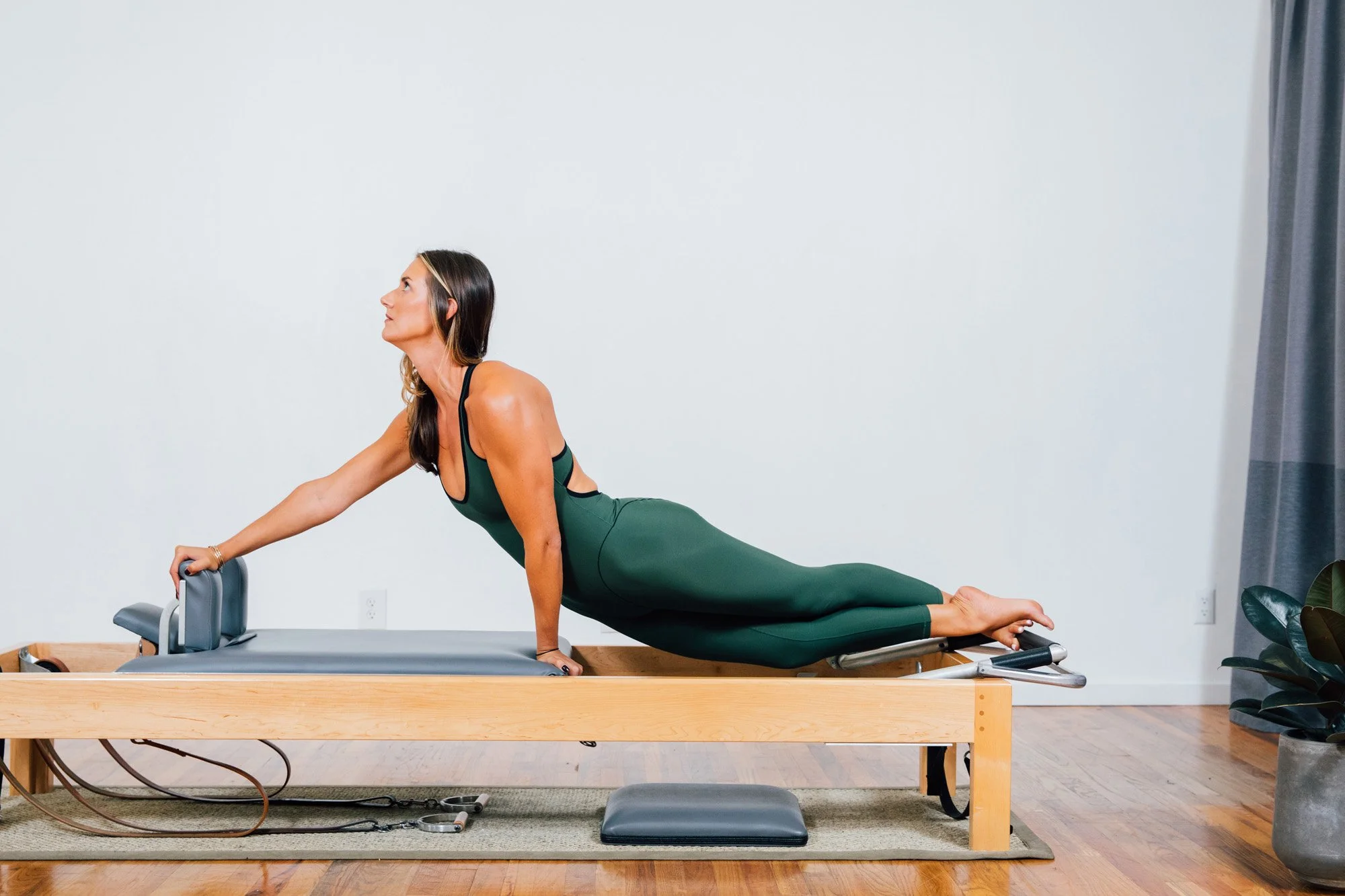
In the contemporary wellness landscape, Pilates has become almost inseparable from the image of the Reformer. Walk into a modern studio or stumble upon a TikTok page and you are likely to find rows of sleek machines, bodies moving in synchronized patterns (and outfits), colored springs providing resistance in carefully calibrated increments- individual mirrors lining walls so bodies can stare at themselves and take the perfect selfie. The experience is efficient, visually compelling, and widely appealing.
But this association - Pilates as Reformer - is a narrowing of a much more expansive method.
“Pilates is not defined by one single apparatus. It is a system of exercise, one that is structured, progressive, and deeply interconnected.”
Its effectiveness lies not in any singular apparatus, but in the relationships between them, and in the order in which the work unfolds.
To understand Pilates fully requires stepping back from the machinery and returning to the architecture of the method itself.
The Original Design
Joseph Pilates developed his work in the early twentieth century under the name Contrology, a term that underscores its central premise: the cultivation of control over the body through the mind. It was conceived not as a collection of exercises, but as a complete approach to physical conditioning - one that integrates strength, mobility, coordination, and awareness.
At the foundation of this system is the Mat.
Without springs or straps, the Mat demands that the body organize itself against gravity. It reveals imbalances with clarity and offers little opportunity for compensation. In this way, it serves as both baseline and benchmark: a place where inefficiencies are exposed and where true strength begins to develop.
From this foundation, the apparatus expand the work.
The Reformer introduces resistance, order, and feedback, supporting movement while simultaneously challenging it. The Cadillac provides structure, allowing for both assistance and increased range. The Wunda Chair condenses the work into a compact, exacting form that requires precision and control.
“Each piece of equipment is distinct, but none exists in isolation. They are designed to inform one another - to create a dialogue that evolves as the practitioner progresses.”
A System of Relationships
What distinguishes Pilates from other forms of exercise is not simply its repertoire, but its organization.
The method is built on progression.
“Exercises are not random; they are sequenced with intention. One prepares the body for the next. Skills are introduced, reinforced, and refined over time.”
The practitioner is not simply moving - they are learning.
This learning is cumulative. The understanding developed on the Mat informs the work on the Reformer. The feedback from the Reformer sharpens the precision required on the Chair. The support of the Cadillac allows for exploration that deepens what has already been established.
In this way, Pilates functions less as a series of workouts and more as a language. Each apparatus offers a different dialect, but all are rooted in the same grammar.
Remove one element, and the conversation becomes incomplete.
The Rise of Reformer-Centric Practice
The increasing popularity of Reformer-based studios has, in many ways, made Pilates more accessible. The machine provides immediate feedback, accommodates a wide range of bodies, and offers a dynamic experience that translates well in group settings.
These qualities have contributed to its widespread appeal.
Yet, this accessibility often comes at the cost of context.
When the Reformer is presented as the entirety of Pilates, the method’s underlying structure begins to dissolve. Exercises are selected for variety rather than progression. Sequences are shaped by time constraints or aesthetic considerations rather than by the logic of the system. The emphasis shifts from learning to performing.
What remains may still be beneficial. Strength is built. Movement improves. But the depth of the method - the intelligence embedded in its design - is diminished.
Beyond Exercise
Pilates, at its core, is not simply about movement. It is about organization and efficiency.
It teaches the body how to distribute effort, how to stabilize without rigidity, and how to move with clarity rather than excess. These qualities cannot be rushed. They are developed through repetition, attention, and progression within the system.
“The apparatus are tools in this process, not endpoints. They provide information -feedback that helps the practitioner refine their understanding of movement.”
But without the broader system, that information lacks continuity.
To rely on a single apparatus is to encounter isolated insights rather than a cohesive education.
The Role of the Teacher
In a system as nuanced as Pilates, the role of the teacher becomes essential.
To teach Pilates is not merely to guide a sequence of exercises. It is to understand the relationships within the method - to know why an exercise appears where it does, what it prepares the body for, and how it connects to the work as a whole.
This requires more than familiarity with choreography. It requires fluency in the system.
A teacher grounded only in Reformer work may deliver an effective class. But a teacher who understands the full scope of the method offers something more enduring: a framework through which the body can continue to evolve.
Preserving the Integrity of the Method
As Pilates continues to grow in popularity, it faces a familiar challenge: how to expand without losing its identity.
Adaptation is inevitable, and in many cases, beneficial. But clarity about what Pilates is - and what it is not - remains essential.
It is not defined by a machine.It is not a format.It is not a trend.
It is a system - ordered, cumulative, and intentional.
To experience Pilates fully is to engage with that whole - to move beyond the machine and into the method itself.
Anything less is an introduction.
@the.pilates.snob
Founder of Real Pilates Montauk, Victoria (Batha) Cuomo is a third-generation classical instructor certified under Alycea Ungaro at Real Pilates NYC in 2016. She also founded The Pilates Snoba brand dedicated to classical Pilates. An avid athlete, Victoria competed forSyracuse University’s D1 Rowing Team in college. She holds a Master’s in Applied Exercise Physiology from Columbia University and teaches on Alo Moves. She’s currently pursuing certification in the Egoscue Postural Therapy Method.