
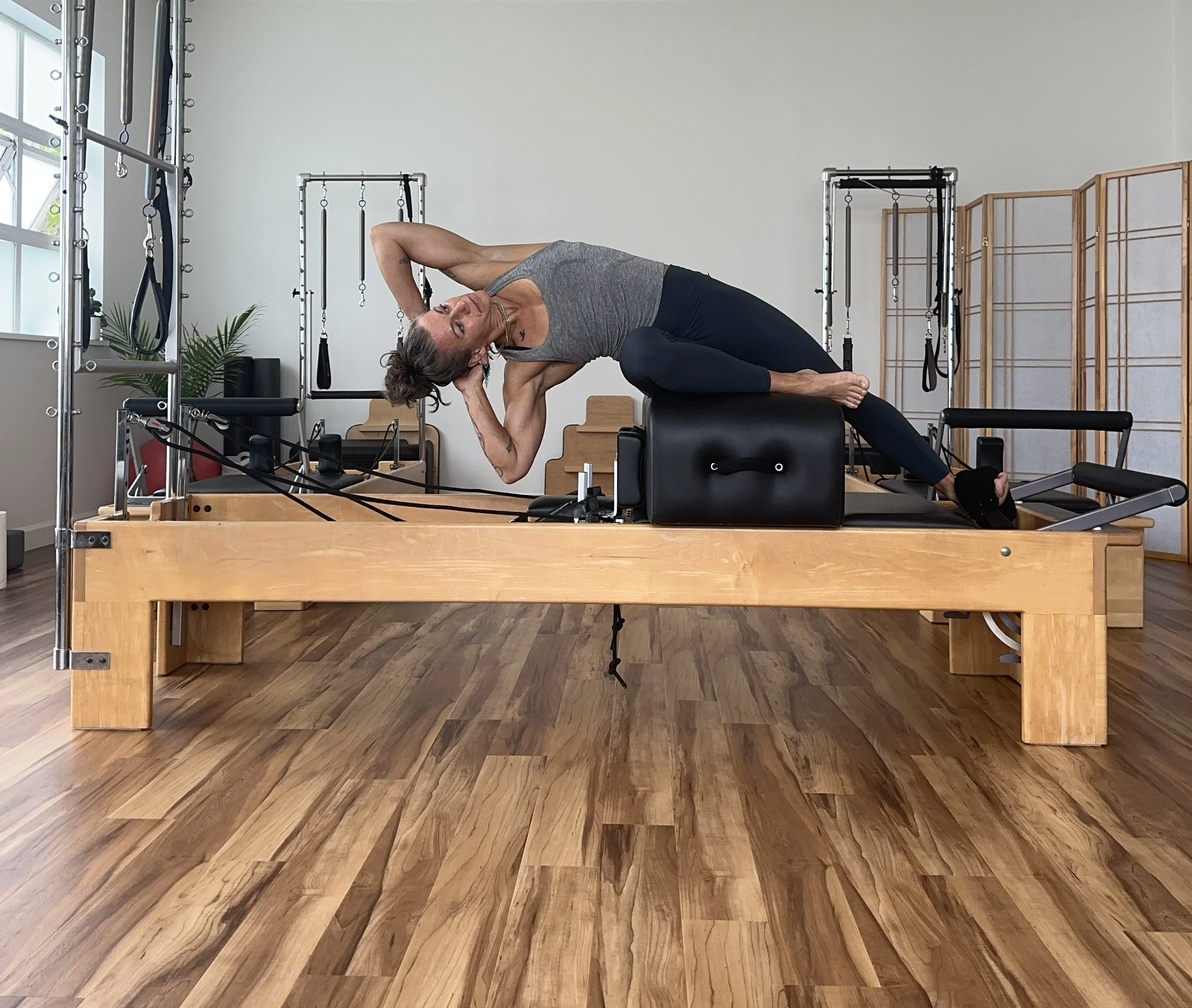
In the Pilates world, we’re often taught to be cautious: move mindfully, avoid “pushing,” protect the client at all costs. And while safety is absolutely essential, being overly conservative with load can quietly undermine a client’s health far more than the occasional, well-managed overload ever will.
Underloading doesn’t just slow progress, it contributes to muscle loss, instability, and the long-term consequences of a sedentary lifestyle. If we want to help clients get stronger, move better, and age resiliently, we must understand the science of progressive loading.
Sedentary Lifestyles Are the Real Risk
Modern life has engineered movement out of daily routines. Sedentariness is now considered an independent risk factor for chronic disease. Research links low physical activity to increased all-cause mortality, cardiovascular disease, metabolic dysfunction, and musculoskeletal decline.
Sedentary behaviour is associated with higher risk of early death and chronic illness, even when adults meet minimum exercise guidelines (Ekelund et al., 2016).
Prolonged inactivity results in rapid loss of muscle mass, strength, and bone density-beginning in as little as 1–2 weeks (Dirks et al., 2016).
Low levels of mechanical loading contribute to osteopenia and osteoporosis (Turner, 1998).
Bone density and tendon health also require regular mechanical stimulation to maintain integrity (Turner, 1998; Kjaer, 2004).
In other words: insufficient load is dangerous. Many Pilates clients arrive with years of under-stimulation. Protecting them from “too much” load often inadvertently prolongs weakness and fragility.
Why Underloading Creates More Long-Term Harm
1. Clients Don’t Stimulate Strength or Tissue Adaptation
Tissues adapt based on the imposed demands- this is the SAID Principle (Specific Adaptation to Imposed Demands).
If the load is too light, the nervous system and musculoskeletal system simply don’t respond.
Muscles need mechanical tension beyond normal daily activity to grow stronger (Schoenfeld, 2010).
Connective tissues require progressive stress to remodel and increase resilience (Kjaer, 2004).
If the load is consistently too light, the body never receives a signal to adapt. Clients essentially “train” their tissues to remain weak.
2. Underloaded Clients Plateau and Lose Motivation
When clients see little change in strength, coordination, or posture, they may feel their efforts are wasted. The problem isn’t the method- it’s the insufficient load. Over time, this can erode adherence and reduce long-term health benefits.
3. Underloading Contributes to Injury Risk
Weakness, not load, is the bigger predictor of injury. Ironically, avoiding load to prevent injury often creates conditions that increase injury risk:
Weak muscles, underdeveloped tendons, and poor coordination are strong predictors of falls and musculoskeletal injuries (Lauersen et al., 2014).
Strengthening tissues through progressive load improves resilience, joint stability, and functional capacity.
Low muscle strength is strongly associated with falls and mobility loss as adults age.
Underloading may feel safe in the short term, but it often leads to cumulative vulnerability. If we avoid loading clients because we fear injury, we ironically create the very fragility we were trying to prevent.
Occasional Overload—Safely Applied—Drives Progress
We’re not advocating reckless pushing. Excessive or poorly planned overload carries risk. But occasional, intentional overload is essential for adaptation.
Progressive overload can involve gradual increases in:
Resistance (springs, body weight)
Repetitions or sets
Time under tension
Range of motion
Speed or tempo
Complexity of coordination
Even small, controlled increases in load can trigger significant tissue adaptation, without causing harm.
Research consistently shows:
Gradual load progression improves muscle strength, joint stability, and bone density (ACSM, 2022; Kohrt et al., 2004)
Strength training is protective against age-related functional decline (Fragala et al., 2019)
Exposure to controlled overload improves tissue tolerance and reduces injury risk over time (Kjaer, 2004; Schoenfeld, 2010)
In short: occasional overload isn’t dangerous when programmed intelligently, it’s what drives the positive changes clients need.
Applying Progressive Loading in Pilates
Pilates is uniquely suited for safe, incremental load progression. Here’s how you can apply it:
Adjust spring resistance gradually – slightly increase tension or resistance as strength improves.
Modify body leverage – move closer or farther from the spring anchor to change demand.
Increase range of motion – larger arcs challenge muscles and connective tissues more.
Alter tempo – slow down eccentric phases or pause at peak contraction.
Add complexity – incorporate asymmetry, balance challenges, or combined movements.
Increase volume – add reps, sets, or sequence length progressively.
Progress toward functional load – include weight-bearing or multi-joint variations to enhance real-world strength.
By integrating these strategies, you can move a client from deconditioned to strong, coordinated, and resilient, without ever needing to “risk” unsafe overload.
Reframing Your Role as a Pilates Professional
Healthy load is not the enemy. Fragility and under-stimulation are. When you apply progressive loading wisely, you help clients:
Build strength and bone density
Improve joint stability and coordination
Enhance metabolic and cardiovascular health
Reduce long-term injury risk
Gain confidence and autonomy in movement
Our goal is not to keep clients comfortable, it’s to make them capable.
Key Takeaway
Underloading may feel safe, but it contributes to long-term weakness, fragility, and the negative consequences of a sedentary lifestyle. Occasional, intentional overload, delivered through a structured, progressive approach, is not only safe, it is essential for tissue adaptation, functional strength, and long-term health.
By embracing progressive loading, Pilates instructors empower clients to build stronger, more resilient bodies—so they can move through life safely, confidently, and with strength that lasts.

ANATOMY OF PILATES helps Pilates instructors feel more confident teaching people with pain and injury through anatomy and post-rehab courses, workshops, and 1:1 coaching.
References:
ACSM. (2022). ACSM’s Guidelines for Exercise Testing and Prescription.
Dirks, M. L., et al. (2016). Short-term muscle disuse induces fiber atrophy and reduces protein synthesis. J Appl Physiol, 121(2), 215–224.
Ekelund, U., et al. (2016). Does physical activity attenuate, or even eliminate, the detrimental association of sitting time with mortality? Lancet, 388(10051), 1302–1310.
Fragala, M. S., et al. (2019). Resistance training for older adults: Position statement from the National Strength and Conditioning Association. J Strength Cond Res, 33(8), 2019–2052.
Kjaer, M. (2004). Role of extracellular matrix in adaptation of tendon and skeletal muscle to mechanical loading. Physiol Rev, 84(2), 649–698.
Kohrt, W. M., et al. (2004). Effects of exercise involving impact or resistance on bone health in older adults. Med Sci Sports Exerc, 36(11), 1985–1996.
Lauersen, J. B., et al. (2014). The effectiveness of exercise interventions to prevent sports injuries: A systematic review and meta-analysis of randomized controlled trials. Br J Sports Med, 48(11), 871–877.
Owen, N., et al. (2010). Too much sitting: The population-health science of sedentary behavior. Exerc Sport Sci Rev, 38(3), 105–113.
Schoenfeld, B. J. (2010). The mechanisms of muscle hypertrophy and their application to resistance training. J Strength Cond Res, 24(10), 2857–2872.
Turner, C. H. (1998). Three rules for bone adaptation to mechanical stimuli. Bone, 23(5), 399–407.