
Are Your Clients in the Right Class Level?
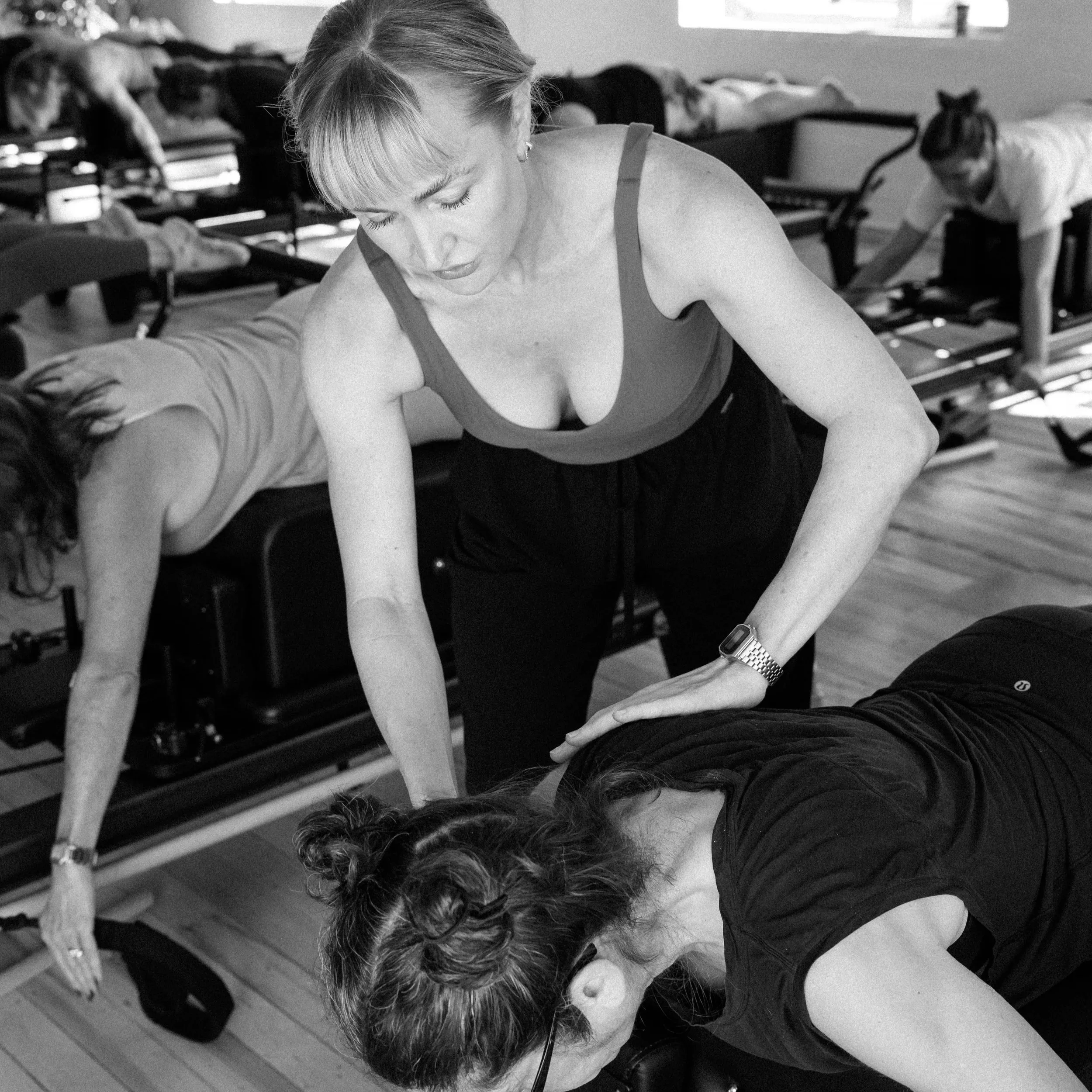
We’ve all been there. A beginner turns up to our advanced class and our class plan instantly goes out the window. After almost two decades of teaching, spanning everything from rehab environments to working with high performing athletes, I can tell you this situation has not become any less common. If anything, it has become more frequent and increasingly complex to navigate.
It used to be simpler. In traditional Pilates settings, the instructor told the client when they were ready to move up. That relationship developed over time, class after class, with an instructor who knew their body, their habits, and their patterns. That model is harder to sustain today. With ClassPass and studio-hopping now a part of Pilates culture, many clients move between studios without forming the kind of ongoing relationship that once made progression feel intuitive.
Fewer studios require a private session before attending group classes, and clients are choosing classes based on time slots rather than level. When clients walk through our doors they arrive with confidence, sometimes even telling us they are advanced, and occasionally that is simply not what we observe. Without a trusted instructor to guide them, clients are largely left to judge their own readiness.
There is also a more uncomfortable truth worth naming. When we stay silent and simply modify to accommodate a client who is in the wrong level, we are not helping them. We are enabling them. They are lulled into a false sense of security, leaving class feeling like they held their own, when in reality the class was quietly reshaped around them. Over time, this can lead a client to genuinely believe they are an intermediate or advanced mover which can lead them into unsafe scenarios as well as disrupt the class around them. A respectful conversation is far kinder than silent modification.
Pilates is, at its core, about mind-body connection. It asks us to cultivate awareness, to listen inward, to notice. A client who has genuinely developed that awareness tends not to ask whether they are ready. They simply know, because the signals are already clear to them. When someone is seeking external validation for a decision their body should be guiding, that is a sign that their self-reading is still developing. And that is okay. It is exactly where we can help.
Giving Clients the Tools to Read Themselves:
We cannot feel what our clients feel. We can observe, cue, and correct, but the internal experience belongs entirely to them. This is why handing clients a clear framework for self-assessment is one of the most useful things we can do. Not to take ourselves out of the equation, but to invite them in.
Over the years I have created and often used a simple self-assessment tool that helps clients understand where they genuinely sit in a group class environment. I share it with new clients, I revisit it when someone seems unsettled in their level, and I use it every time a client asks me ‘how many beginner classes should I complete before moving up to intermediate?’.
Client Self-Assessment Tool for Group Classes:
They know their springs for familiar exercises, such as Footwork and Bridging
They select the more challenging exercise variations on offer, for example double leg stretch instead of single, full Hundred’s with legs straight instead of table top.
They choose the more challenging spring selections, and they understand that sometimes lighter springs are the more challenging option.
They do not require rest while others are resting.
They are not currently injured, or if they have a niggle, they can manage it independently within the group class setting.
They generally understand most of the concepts being taught; for example, they understand the difference between articulating through the spine and hinging at the hip.
They feel good during and after class. They are not wiped out after every single session.
In my experience, when a client can tick all seven of these consistently across three classes in a row, that is their signal to move up. It has to be three consecutive classes. One good session is a good session. Three in a row is a pattern.
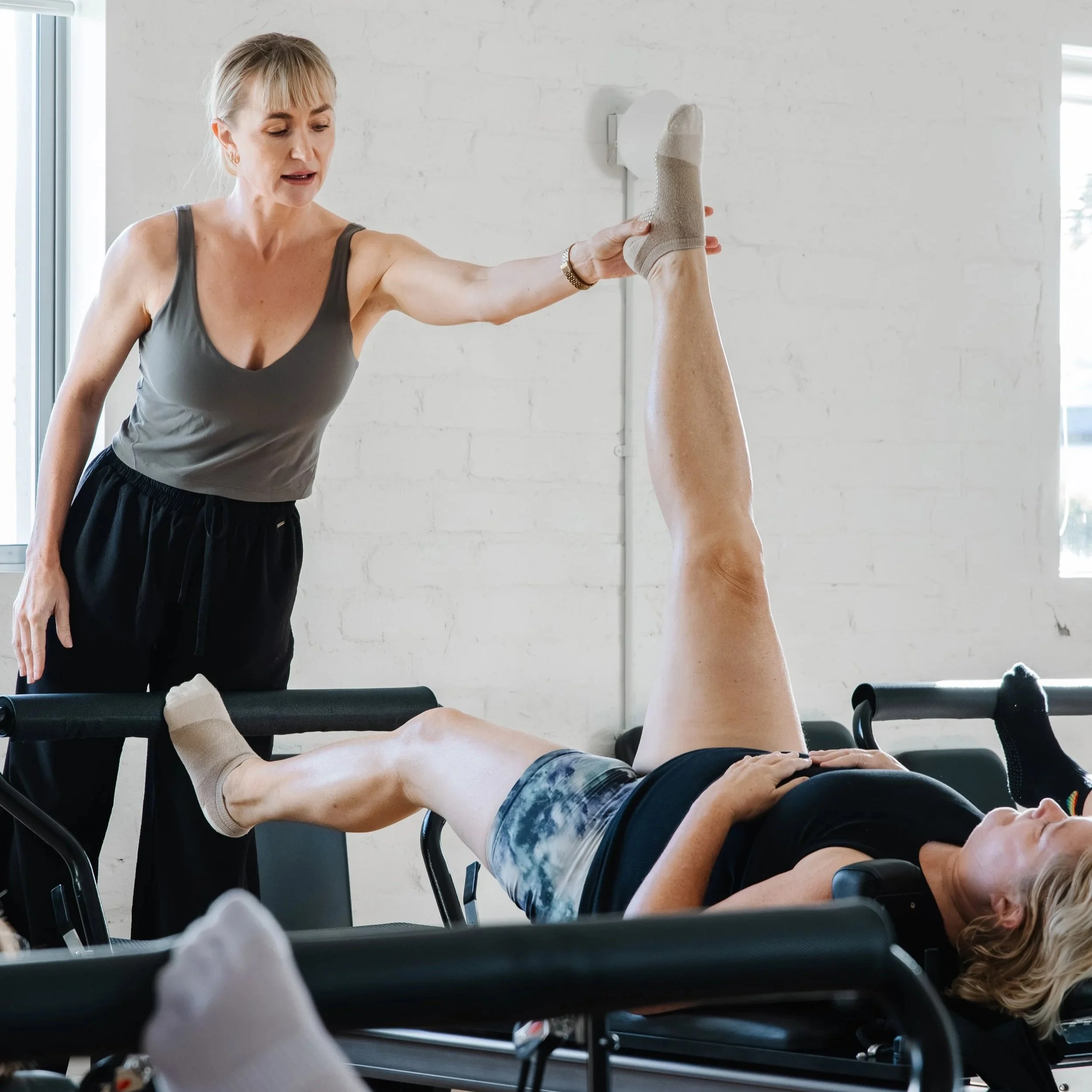
I met a client not long ago who had been attending intermediate classes at other studios for months. She had convinced herself she needed to be in an intermediate class to get the best challenge and bang for her buck, but she was struggling every single session and blaming herself for being weak and not ‘keeping up’. She was not enjoying Pilates. Because the instructors never said anything, she assumed she just had to keep going until she got stronger.
When she came to me I introduced her to the self-assessment tool straight away, and it was a genuine lightbulb moment. She realised there was so much more she could be doing within the beginner level: taking more challenging variations, exploring different spring selections, really owning the exercises she already knew and getting the most out of every class. She left that conversation feeling empowered rather than deflated and within a few weeks she was getting so much more out of her classes. She had even started tracking her spring settings so she could really challenge herself. As she put it: 'I thought that was just what Pilates felt like. Now I am addicted.' That is exactly what this tool is designed to do."
Advanced Thinking, Not Just Advanced Movement:
Being advanced is not simply about performing harder movements. It is the heightened awareness of your own body, a keen sense of the environment around you, and the ability to move with complete intention and control. The most experienced clients I teach tend to have the fewest questions. They have become observers of their own system. They notice when something feels off, they adjust without being prompted, and they make decisions in the moment that serve their body rather than their ego. That quality of attention is what progression in Pilates really looks like. It is not just alignment of the body. It is alignment with oneself.
This is why keeping a client at the right level is not about holding them back. It is about keeping them safe and giving their self-awareness time to catch up with their physical capability. Our role is to keep them safe in the class they are in while educating them about what readiness actually looks and feels like from the inside. If we did this more often, we would reduce the number of Pilates related injuries. A number that is increasing rapidly.
Give your clients this framework. Share it early, revisit it often, and remind them that the goal is not to race through levels. The goal is to develop the kind of body awareness that makes every level feel purposeful. When they can read themselves clearly, they will not need to ask you whether they are ready. They will already know.
Shanelle Lenehanis a certified Pilates Instructor, Studio Owner, Mentor, and Educator nearing two decades of experience. Based in Auckland, Aotearoa | New Zealand, she is Lead Trainer at Unity Studios, guiding a 46-strong team and class offerings across three sites, Mentor and Educator with Polestar Pilates, and a member of Pilates Aotearoa's education. She runs workshops and mentors instructors online and in person.